Showing posts with label WWII British. Show all posts

23 December 2021

[20mm] First Canadian Squad

I'm still experiencing problems with Blogger on my Apple devices. Instead of getting better it's getting worse. Somehow I have the feeling they're trying to force me to use their bloomin' Chrome browser as every other browser I've used so far wouldn't work. So apologies (again) to all the fine people on who's blog I failed to comment. 

Todays offerings are my first painted squad of Canadians. I've painted them as PPCLI (Princess Patricias Canadian Light Infantry) as I want to use them for Italy in the long run. That said I won't be shy and will field them in France just as well.

24 October 2021

[20mm] Airborne Jeep with German & British Crew

As some of you may be aware, my good friend Curt of analogue-hobbies.blogspot.com fame and I have a miniature exchange ongoing. Not sure for how long but by now a fair few figures have crossed the Atlantic either way to find residence on another continent. For this years figure I was at first at a loss as what to paint, when Curt made a fleeting remark about wanting to do a force for OP Market Garden at some point. And there it was my inspiration. 

Picture taken from https://europeremembers.com

04 February 2021

Wrapping up the Airborne project

Yet another submission to the AHPC:

I'm sure many of you know the feeling. In the one moment you're happily beavering away on a project when all of a sudden you feel it has run its course. For the moment at least. Now that's exactly what happened here. I got a few more British Airborne for Operation Market Garden done and that'll be it for now. I might get my acts together and add a few things to round out the opposing SS force... or I might not. We'll see.

28 January 2021

1940 BEF - Matilda II

Yet again another entry in the Annual Analogue Hobbies Painting Challenge. At the moment I'm experiencing a rather uncommon quiet time at work meaning I find myself with more time at my hands to pursue the hobby.

24 January 2021

British Intelligence Officer

The Annual Analogue Hobbies Painting Challenge is still going strong, so here's my fifth submission for those of you who don't follow our progress there:

Another chamber that took some heavy head scratching. I mean, like many of you I do have a few Fantasy figures flying about the place which would have fit the bill. But I'm not a Fantasy gamer and only once in a blue moon actually fancy the idea of painting anything Fantasy. Thus I was on the verge of skipping this chamber...

12 January 2021

Para Support Choices

The Annual Analogue Hobbies Painting Challenge is in full swing, so here's my fourth submission for those of you who don't follow our progress there:

As we step into the chamber, portentously named Pit of the Pendulum, we stop dead in our tracks. "What's that? That's no bloody pendulum!" we mutter to ourselves as from out of the dark comes a trio of men in camouflage smocks. Their faces, half hidden beneath their helmets, curiously distorted by the dim flicker of a flame not bigger than a candle. It's only when they stop just a few feet away that we realize with horror it's no candle but the pilot flame of a flame thrower...

06 January 2021

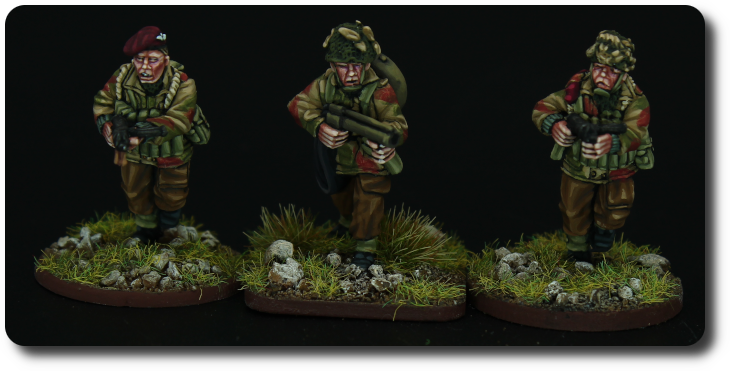
British Paras

As some of you fine folk may know I'm eagerly (ah, well more like glacial-ish) painting away on a 28mm Para force for gaming Operation Market Garden since... ahem... since AHPC VI, so 2014 actually. Now I bet that wouldn't strike even the slowest painter amongst us as particular ambitioned, or indeed eager, and rightly so. Having painted a playable SS force as opponents over the course of that (wretched) last year I decided I better get my finger out and finish those Paras.

20 March 2020

Princess Patricias Canadian Light Infantry - 1st Section... and some KSK

Being ordered to stay at home for the day till the company has decided on how we field-service technicians are best and safest to proceed with our jobs in face of the virus I've taken the chance to take pictures of finished stuff. These lads have been sitting on my desk for a few days now as I haven't had found the time to finish the basing. 


05 February 2020

Hans! Hände hoch!

Another entry to the Annual Analogue Hobbies Painting Challenge by yours truly:

A last stand you say? Well, if there’s been one iconic last stand in WW2 than it must clearly have been the Battle for Arnhem during Operations Market and Garden. Of course there were others too but this one instantly sprang to mind and coincidentally I'm slowly collecting a force of Paratroopers for it.

Paras on their way to the bridge

15 January 2020

British Paratroopers Colour Guide

Hot on the heels of last weeks Colour Guide on how I paint my Early War Germans I felt suitably inspired to write another one. But this time I'll not tackle some obscure German unit but British Paratroopers. The world famous Red Devils. I'm beavering away on this force for several years now but as of yet there's not nearly enough for a game. Another particularly useful list of colours for British Airborne Troops by Tamsin can be found over on her blog: wargaminggirl.blogspot.com
She has probably done way more research for her British Airborne Project (which by the way is also actually finished) than me. So if in doubt I'd go for her paint suggestions.

Model painted earlier


My painting style is based on the so-called Triad-System or Foundry System in which you use a Shade as the darkest colour. Then you paint over it using what is called a Base Colour (in general the actual colour you want to achieve for the piece you're just painting) leaving the Shade show only in the folds and recesses, followed by a Highlight on the points which will catch the most light. However, I'm using intermediate steps to make the transitions between the different colours much smoother.
Thus typically the steps I use would look somewhat like:

Shade - 50/50 mix Shade/Base - Base - 50/50 mix Base/Highlight - Highlight

In general what I'll give you in this tutorial is the three colours as if used as simple triads. If you prefer the more elaborate approach just add in the intermediate steps mentioned above, or start from an even darker Shade or end with a lighter Highlight.

If fractions in brackets are given these are just approximations. Just try what looks best to you.


Note: I haven't documented every single step for this Colour Guide, so you might want to refer to some of the guides I wrote earlier. To do so just go to the top of the page where you'll find a link to a page containing direct links to all the Colour Guides I wrote to date.

Step 1: Battledress
Most commercially available Paratrooper figures out there will probably all sport the famous Denison smock. So this step will basically only ever concern us for the trousers of the battledress.

A: VMC 70.941 Burnt Umber
B: VMC 70.983 Flat Earth
C: VMC 70.983 Flat Earth + VMC 70.819 Iraqui Sand (1/1)


Step 2: Denison Smock Base
As usual I went a little lighter on the base colour than is historically accurate. This will help the figures to stand out a little more on the gaming table. And you can always blame fading.

A: VMC 70.873 US Field Drab
B: VMC 70.873 US Field Drab + VMC 70.819 Iraqui Sand (7/3)
C: VMC 70.819 Iraqui Sand +  VMC 70.873 US Field Drab (7/3)

 Step 3: Webbing
I used to use different colours for ruckscks, gaiters and other webbing but found the overall effect wasn't worth it. After all the webbing worn by British troops in WW2 (and well after) was blankoed by the soldiers themselves. Thus I think it's highly unlikely for a soldier to carry equipment in such different hues that it'd really stand out on a 28mm figure.

A: VMC 70.924 Russian Uniform
B: VMC 70.924 Russian Uniform + VMC 70.819 Iraqui Sand (8/2)
C: VMC 70.819 Iraqui Sand + VMC 70.924 Russian Uniform (7/3)


Step 4: Camouflage Patches
In order to recreate the faded look to the camouflage patches that is so emblematic of the Denison Smock I use glazes. A glaze is paint highly diluted with a medium (e.g. water or even better a Glaze Medium) to a point where it gets semi-translucent. One drop paint to about four drops of medium should be sufficient. Then the wet brush is dragged over a piece of kitchen paper until it's almost dry.


Now draw the moist brush in random strokes all over the smock. In fact it actually makes sense to do this step before painting the webbing equipment. Should the paint be too translucent for your liking just go over it again when the first layer has dried sufficiently. After this use the other colour and repeat the process. Make sure to let the colours overlap in some places. The nice thing about glazes is similar to washes the shading will happen automatically.

Glaze A: VMC 70.975 Military Green
Glaze B: VMC 70.982 Cavalry Brown


Step 5: The Red Beret
In fact the Beret should be more maroon than a bright Ferrari red, something Tamsin let me know back when I did my first Paratroopers all those moons ago.

A: VMC 70.814 Burnt Red
B: VGC 72.012 Scarlet Red
C: VMC 70.946 Dark Red

Step 6: Helmet Cover
Unlike the German Wehrmacht which often used helmet covers with printed on camouflage patterns the British used netting to disrupt the shape of their helmets.

A: Wetbrush VMC 70.975 Military Green
B: Drybrush VMC 70.924 Russian Uniform


The scrim (?) came in many different colours ranging from a dark green over a deep, reddish brown to almost beige. For sake of contrast I decided on a light, almost beige brown.

A: Wetbrush VGC 72.062 Earth (VMC 70.983 Flat Earth works just as well)
B: Drybrush VMC 70.819 Iraqui Sand + VGC 72.062 Earth ( 7/3)

 Step 7: Rifle stock
As I changed over from Foundry to Vallejo paints I also had to look for a replacement to my trusty Spearshaft triade which I previously had used for almost anything wooden. So that's the closest I came up with to date (Don't know why there's Flat Earth instead of Beige Brown in the picture).

A: VMC 70.940 Saddle Brown
B: VMC 70.875 Beige Brown + VMC 70.843 Cork (8/2)
C: VMC 70.843 Cork

So another Colour Guide done and just a few hundred left before I've finally covered any uniform variation worn during WW2. If you found this guide useful, have a question or remark concerning this or earlier colour guides or you'd like me to do a particular colour guide in the future just let me know in the comments below.

08 December 2019

British Paras, BEF JoP's and a building

Today an a little diverse diverse mix as I'm trying to tie up some loose ends before the 10th Annual Analogue Hobbies Painting Challenge starts in a matter of days.
Work-life balance is a little difficult at the moment as I've only just started a new job and thus am constantly away from home for the foreseeable future. So there's precious little hobby time to be had.
Be that as it may, I've actually managed to paint up a few things.

Let's start with a demi-squad of British Paras:


02 November 2019

1940 BEF - 25mm Hotchkiss anti-Tank gun

To counter the threat posed by German Panzers I wanted another anti-tank gun to support my BEF. As I already have a QF 2-pounder anti-tank gun my attention turned to another piece fielded by the British at the beginning of World War II: The French made 25mm Hotchkiss anti-tank gun.


18 October 2019

1940 BEF - 2nd 2" mortar, additional riflemen & Platoon Sergeant

One thing I came to recognize in our last games was the effectiveness of the British 2" mortar when deploying smoke. So I swiftly decided to paint me up another one as a support option. I also needed another two riflemen to bring up all of my four sections to the 11 men required for a 1940 Regulation BEF Platoon. And last but not least, as I'm rather a stickler for WYSIWYG,  a Platoon Sergeant armed with a rifle. All models are Warlord Games.


30 August 2019

MG 08/15's and British Para

One option for a German force in the 1940 Blitzkrieg handbook for Chain of Command is the use of the iconic WW1 vintage MG08/15 for lower quality troops. As there's currently no manufacturer out there doing Wehrmacht figures armed with that venerable piece of equipment I had to resort to WW1 Germans from Renegade Miniatures. Great War Miniatures also offer a set with beautifully sculpted MG08/15's with crew but these are unfortunately sporting putties instead of jackboots unlike the Renegade ones. So being neither skilled nor patient enough to pull of greater works of conversion I settled on the Renegade figures. They received simple head swaps and most of their telltale WW1 equipment was filed off and replaced by bits from various plastic German sprues by Warlord Games. Good enough for gaming purposes.


24 August 2019

1940 BEF - Bofors 40mm gun

Despite their use in France in 1940 for some inexplicable reason there's no entry for the famous Bofors 40mm anti-aircraft autocannon in the Blitzkrieg 1940 handbook for Chain of Command. Still I rather fancied to get me a model of this iconic gun for quite a while already. And even if it's just as an off-board marker for having purchased an AA-asset. Now having recently ordered some reinforcements for my BEF from Warlord Games I included their version of the Bofors gun as it was in use in 1940. Well, the kit has some issues, especially where historical accuracy is concerned, for example the NCO is carrying the later P-37 entrenching tool, but still is rather nice all round.


21 July 2019

There Are Many Rivers To Cross - Game 1: The Village

Thursday, 6th of June 1940 just south of Veckring, France. The morning mist has just dissipated and it promises to become a warm and pleasant day. The forecast says 20°C and a little windy. You can hear the thunder of artillery and the drone of bombers in the middle-distance. Everybody is edgy, something is in the air.


13 July 2019

There are many rivers to cross - The cast

I've been tinkering away on German and British forces for the Invasion of France in 1940 on and off for quite a while now. And finally it's time for them to see the field of battle for the first time. Mate Chris aka Axebreaker of christopher-bunkerhill.blogspot.com fame and yours truly have decided to start a campaign set in France in 1940 shortly after the commencement of Fall Rot, the second phase of the German invasion.
As a basis we use the "There are many rivers to cross" campaign for Chain of Command which can be found in the 2018 Lard Magazine. We try to be better in keeping you up to date with events as they unfold as we were with other campaigns. To this end I'll try to update this post as often as possible with all the relevant news concerning your favourite characters. I'll also create a dedicated page where you can (hopefully) soon find the reports of the actions as they were fought.


Disclaimer: Any resemblance to real persons, especially those of wargaming extravaganza, is purely intentional. Should any of the people I took for inspiration recognize themselves I hope you take it for the good-humoured jibe it was meant to be. In the unlikely case that should anybody else feel the desire to be featured in this adventure just let me know. I'm sure as soon as the bullets start to fly and casualties start to mount there'll be plenty of opportunity for men from the ranks to fill the boots of those who've gone before them.


The forces of her Majesty - Defenders of Liberty and Democracy


The Platoon is part of the 8th Battalion, Argyll and Sutherland Highlanders of the 51st (Highland) Infantry Division. The Division was mobilized in August 1939 as part of the Territorial Army and was sent to France in January 1940. There they were placed under command of the II Corps of the British Expeditionary Force. Till March the Division underwent a significant reorganisation during which some of its formations were replaced by units from the regular Army. This was done in order to strengthen the comparatively inexperienced Divisions of the Territorial Army. In April the Division came under command of the French 3rd Army and was stationed in front of the Ouvrage Hackenberg Fortress which was part of the Maginot Line. After the commencement of hostilities the 51st (Highland) Division did not take part in the fighting in Belgium and thus didn't withdraw to Dunkirk.
When the Germans opened their second offensive, the so called Fall Rot, the Division was tasked with holding a sector 5 to 6 times larger than could normally be expected of them. And that's where the journey of our valiant heroes begins...


The Platoon Commander
2nd Lieutenant Martin McMutton
2nd Lieutenant Martin McMutton is born in 1904 in Barrhead, East Renfrewshire as only son of well known local Doctor Douglas McMutton and his wife Drew McMutton. His mother dies of fever when he's still a toddler and thus he is brought up by his father who teaches him iron discipline, the rightful fear of god and instills in him a deep love of classical poetry.
When his father is called upon to serve as a medical officer in the Great War Martin is sent to Duke of York's Royal Military School for education. Being easily distracted and admittedly a little lazy he barely makes his grade and instead of pursuing a military career he then goes on to become a mechanic in the booming refrigeration industry.
He marries Paisley Robertson in 1929 and together they have two daughters Kacey and Annabelle. When the shadows of yet another war begin to gather over Europe he feels the obligation to make himself available to the armed forces of his Majesty. Being almost too short for a place on her majesties payroll it's due to his military school training that Martin is eventually enlisted as an officer into the 51st (Highland) Infantry Division in December 1939.

The Platoon Sergeant
Sergeant Curtis P. Campbell
Born in 1911 Curtis Campbell was a factory worker in his former life. As an intellectual looking man of average stature, sporting an imposing mustache in his hometown of Broxburn, West Lothian, he is well known for his love of a good (or cheap, whatever is to hand really) glass of red and his passion for the sound of dice on a gaming table. Just when some 'interested' party, wanting to be reimbursed for their expenses, is about to pay him a visit  he rather unexpectedly discovers an urge to defend the rights of the oppressed and downtrodden and goes to join the International Brigades in Spain early in 1937. However his stay is relatively short and so he leaves Spain following the Battle of Teruel to further Republican goals abroad. After the fall of the Republic he returns to Britain and enlists in the Army. His experiences in Spain help him to rise through the ranks and by June 1940 he finds himself Sergeant and 2iC of a Platoon. Quite to his own astonishment actually.

Corporal 1st Section
Corporal Christopher O'Sliter - 1st Section
At 26 O'Sliter is actually one of the older men in the Platoon. Of short stature, but never one to be messed with, Christopher has an artistic streak and when he's not momentarily occupied with shaping his section into the best section of the Platoon, if not the whole damn army, he can often be seen painting small figurines by the light of a small lamp and the sound of the radio at his desk. Before his military service he tries to make a living of his artistic skill, but the world probably wasn't yet ready to support a living based on painting military figurines to almost naturalistic detail. So as a way out of poverty he decides to join the army. Actually intent on joining the Royal Tank Corps, O'Sliter somehow walks through the wrong door at the recruitment office and ends up in the 51st (Highland) Infantry Division.

Corporal 2nd Section
Corporal Patrick Smyth - 2nd Section - Field promotion
After Corporal Dockertys untimely demise Patrick Smyth gets a field promotion to Corporal and is put in charge of 2nd Section. Born in Musselburgh, East Lothian, in 1919 he's a gardener by profession. Despite his young age he's famous throughout the county and beyond for his skill. His specialty is the recreation of naturalistic looking landscapes in even the tiniest gardens. Rumor has it he's even managed to squeeze a little copy of an Italian hill-town into his latest project. The demand for his services has even led to him writing a book wherein he discloses many a secret of his art to those aspiring to emulate his works. When war breaks out in Europe it finds Patrick working on his second book. Despite the well advanced stage of this second installment he feels the obligation to answer the call to arms and enlists in the 51st (Highland) Infantry Division. In the evenings and during lulls in the fighting he can often be seen writing  and making sketches of the springtime french landscape. Could it be that he's gathering materiel for even a third book?

Corporal 3rd Section
Corporal Michael Awry - 3rd Section
Born in 1917, in the middle of the Great War, Michael grows up in Kilwinning, North Ayrshire. Having lost his father to a German artillery shell in Flanders in 1918, he joins a circus when he's still a boy. Tall and thin his skills as a juggler and entertainer have already earned him quite a reputation throughout the realms of King George VI when answering the call to arms in the aftermath of the Munich Crisis. How on earth he ended up as Corporal he's not quite sure himself. Must have had something to do with his ability to focus on the job at hand, not succumbing to temptations of any kind.


The dead and missing:

Corporal Davis D. Dockerty - KIA
25 years of age and a strapping six-footer Davis Dockerty was a Clerk at the General Post office and deep within he still is. His head for figures and aptitude for paperwork makes him well liked by the company quartermaster and in return by his men as well. He's well known for his good spirits under even the most dire of circumstances. Davis reportedly was seen staging a grand scale what-if game centered around a joint anglo-american invasion of France against a hypothetical German occupation force as part of a training exercise for the men of his section. This earned him a reprimand from his Lieutenant as it's absolutely unthinkable the Germans could ever be able to boot the BEF out of France, let alone subdue the mighty, if admittedly a little inflexible, French Army.
Davis is killed on the 6th of June while trying to shore up the left flank of the platoons positions in the face of the German onslaught.

Men of the Reich - Saviours of Europe from Bolshevism


7th Panzer Division (Ghost Division)
Kraftradschützenbataillon 7 (7th Motorcycle Battalion)


Der Zugführer
Leutnant Dieter Steindorf
Dieter's upbringing was a comfortable middle class with 4 siblings in the large capital city of Berlin. In addition to his excellent performance in the regional Realschule Dieter was fortunate enough to have a father who served with distinction in the Great War thus helping him in getting a commission in the Wehrmacht in the newly formed Panzer divisions. Keen to be at the tip of the action he requested a leadership position in the specialized Motorcycle Reconnaissance Battalion and was granted command of the first platoon.
He is 26 years old and stands about 5ft 8in. His father not wanting his son to get soft had him working part time laying and carrying bricks in addition to strength related sports has resulted in Dieter looking like bricks he used to carry a virtual block of a man.


Der Feldwebel
Feldwebel Heinrich Zornburg
Born and raised in the inner city of Dresden hardened Heinrich to the realities of life. His father worked in the local armaments factory supporting a large family made making ends meet difficult at time so Heinrich went to work at a young age getting work where he could to help support the family, before joining the Hitler Jugend gaining a reputation for an iron will leading local groups. As soon as he could he joined the Wehrmacht at 18 years old and due to his will and training in the Hitler youth he rose rapidly to the rank of Feldwebel at a young 20 years of age.Thin and rather pale belies a strength of will and body that impress all who come into contact with him.


Führer 1. Trupp
Obergefreiter Hans Schwarzfuss, 1. Trupp
Hans was born and raised in the small village of Linzdorf in Saxony working and living on the family farm. All that heavy lifting turned an already very tall Hans into somewhat of a lumbering giant. A model citizen and thanks to his disciplined upbringing Hans found life in the Hitler youth easy to adjust to and equally found life in the Wahrmacht to suit him well.
At 21 years of age Hans is ready for to lead his squad into France even with the laughs and smiles he gets when fitting his bulk onto his motorcycle, but knowing he has the squads respect he takes it with a good nature and bidding joke with his men.


Führer 2. Trupp
Obergefreiter  Wolfgang Obermann, 2. Trupp
Hailing from the west in the large city of Cologne 21 year old Wolfang dreamed of an adventurous life outside the dreary office job he was saddled with so jumped at the chance to join the Wahrmacht and even better ride a motorcycle while doing it! All that office work has left Wolfgang a bit pale and on the thin side which he hopes to change, but sadly it seems nobody can cook in the army so will likely need to wait until he gets married after the war!

Führer 3. Trupp

Obergefreiter Heintz Kellermann, 3. Trupp

Taking over for the recently deceased Johann Waldarm is Heintz the "old man" of the platoon at 33 was born and raised in Obermenzing near Munich Bavaria and made a living as a game keeper on a large country estate that Reichsmarschall Göring used on occasions. Heintz is of average height and build and tends to be rather quite from all his solitary work on the estate, but is easy going and well liked in the platoon(even more so when shooting for extra meals for the squad to improve the rations!) While Heintz was content being the squads "dinner man" both he and the men took it as no surprise Heintz was raised up as the replacement to Johann, but as leader of squad will take an adjustment for everyone nonetheless.

The dead and missing:

Obergefreiter Johann Waldarm - KIA
An average looking 19 year old citizen in all respects working as an office clerk in the northern city of Hamburg Johann answered the call of his country and joined the Wahrmacht to serve his Fatherland. Usually accustomed to paperwork his quick wit allowed him to adapt to the army life and his ability to navigate came to attention of his superiors who assigned him to the Motorcycle Battalion to take advantage of this ability to scout ahead. Johann is killed on 6th of June 1940 in his first engagement with the enemy.

14 March 2019

1940 BEF

Having just added to my Early War Germans I felt it was about time to add a little to their opponents. Some of you might remember earlier efforts of mine (has it really been 4 years again?)  on much the same figures. Believe it or not it took me the best part of a month to get these fellas done and dusted. I blame a rather busy schedule with me being away from home for the most part of that time.

26 May 2017

Even more Red & Green Devils

While I'm rather productive at the moment as far as painting is concerned, I've become quite lazy when it comes to posting the results of said productivity. Painting wise I felt like continuing with my Italian campaign WW2 project. First off is a command group for the Red Devils


25 December 2016

Red Devils on the prowl

I actually wanted to start this post ranting about the latest update to the Blogger Dashboard...
but it being Christmas Day and all I decided to save my breath. But I'm in all honesty considering to stop using Blogger. It became a pain in the butt to work with on the tablet and thus I'm considering different possibilities for the future. Also I want to apologize for a lack of comments on your collective blogs. I'll try to make good for that in the next few days. But that's enough of my whining for now, so on to the miniatures I'd say!